A Word Before We Begin
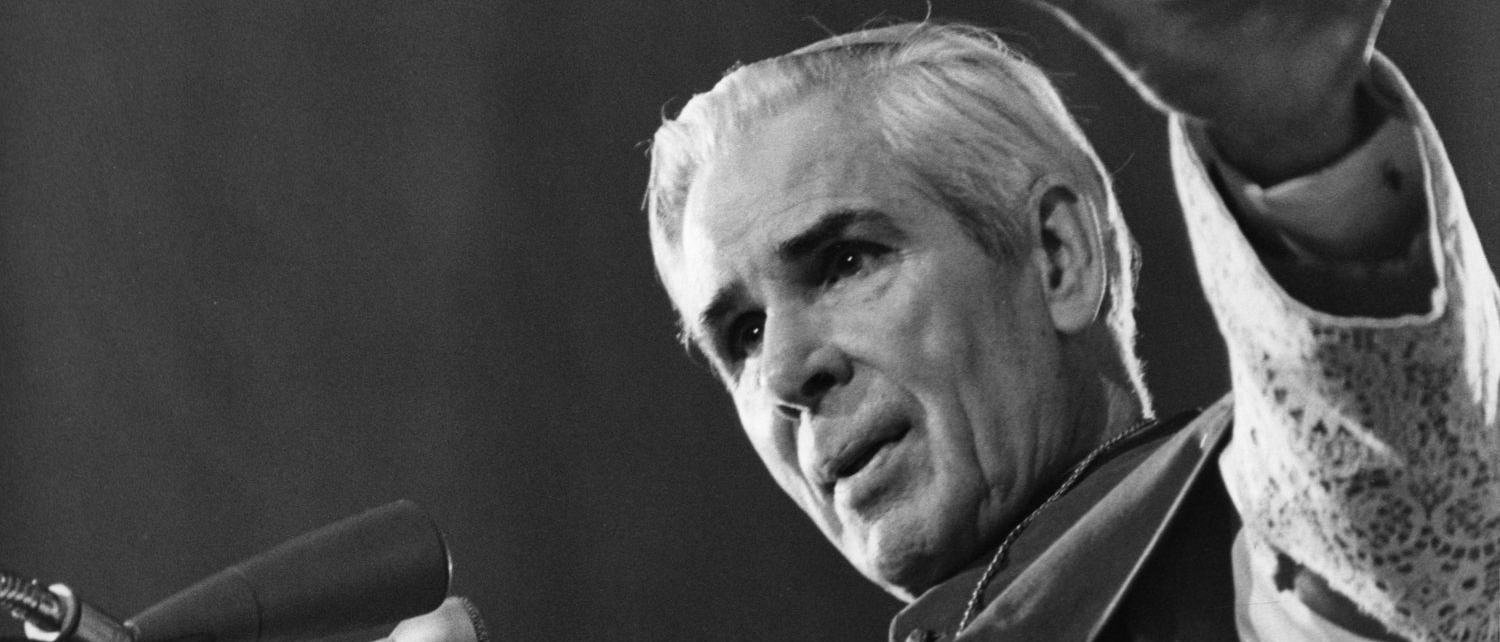
Millions of people met Fulton Sheen the same way. They turned on a radio, or later a television set, and there he was: a bishop in a cape, chalk in hand, speaking about God as though God were the most interesting subject in the world. To him, He was.
But the man on the screen had a hidden life behind him. Every day of his priesthood he spent an hour before the Blessed Sacrament, and he insisted that everything else, the books, the broadcasts, the conversions, flowed from that hour.
This is his story in brief, told simply: not every detail of a long life, but its shape and its heart.
A Boy in Illinois (1895 to 1913)
He was born on 8 May 1895 in the small town of El Paso, Illinois, the eldest of four sons of Newton and Delia Sheen. His parents were of Irish stock and kept a modest hardware store.
He was baptized Peter John. His mother placed him under the protection of the Blessed Virgin Mary at his baptism, a dedication the boy himself renewed on the day of his First Holy Communion. Mary would remain at the centre of his spiritual life for the next eighty years.
As a small boy he came to be called by his mother's maiden name, Fulton, and the name stayed with him for the rest of his life.
When he was about five, the family's business took them to the nearby city of Peoria. There he went to school, served Mass at the cathedral, and did well at his studies, both in the ordinary subjects and in the humanities.
The Call (1913 to 1919)
In 1913 he entered St. Viator College at Bourbonnais, Illinois, a school run by the Clerics of St. Viator. It was during these years that the call to the priesthood became unmistakable to him.
The decision cost him something. A scholarship for further study had been offered, and he turned it down in order to enter the seminary. He was received at St. Paul Seminary in Minnesota.
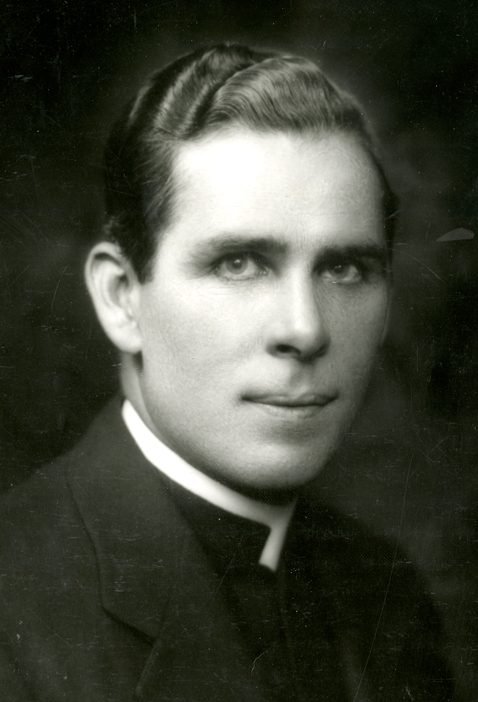
On 20 September 1919 he was ordained a priest of the Diocese of Peoria at St. Mary's Cathedral. On that day he made the promise that would shape everything else: a daily Holy Hour before the Blessed Sacrament, which he kept faithfully until he died.
The Student in Europe (1919 to 1926)
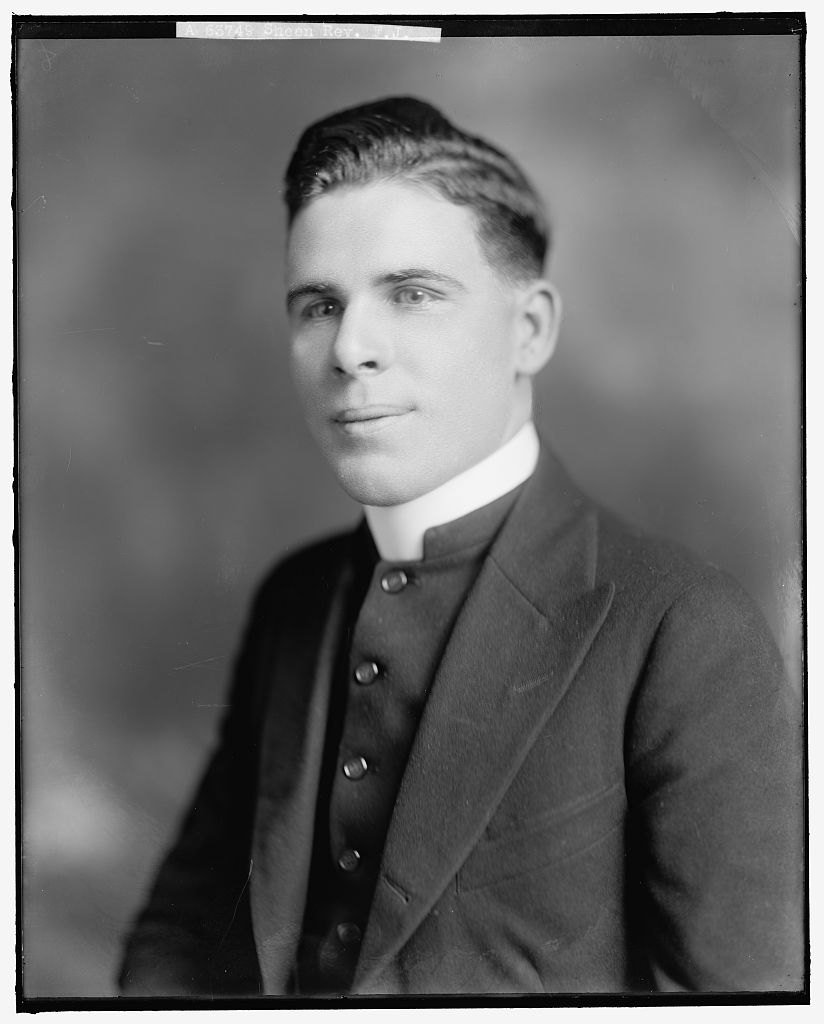
The young priest was sent on for further study. In 1920 he took his bachelor's degrees in canon law and in sacred theology at the Catholic University of America in Washington.
He then crossed the Atlantic to the Catholic University of Louvain in Belgium, where he earned his doctorate in philosophy. In 1923 he was awarded the Cardinal Mercier Prize for International Philosophy, the first American ever to receive it.
In the academic year 1924 to 1925 he was entrusted with a course in dogmatic theology at St. Edmund's in England.
On 6 July 1925 he returned to Louvain and passed, with the highest distinction, the demanding final examination known as the agrégé, which qualified him to teach philosophy with the rank of professor. Few men attempted it. Fewer still passed it as he did.
The Professor (1926 to 1950)
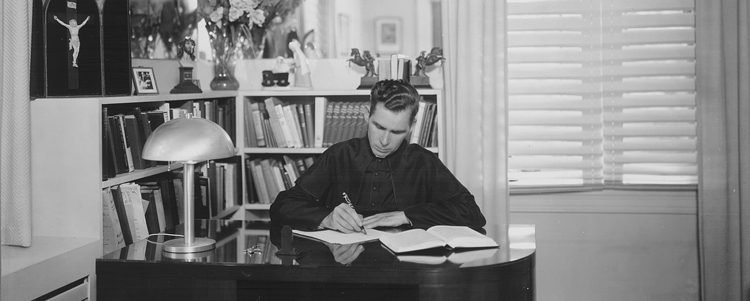
He came home to America and was appointed to the faculty of the Catholic University of America, where he taught theology, and then philosophy and religion, until 1950.
Those twenty-four years in the classroom are easy to overlook, but they explain much of what came later. The clarity that made him so effective on the air was the clarity of a trained philosopher who had learned to say difficult things plainly.
The Voice on the Radio (1930 to 1950)
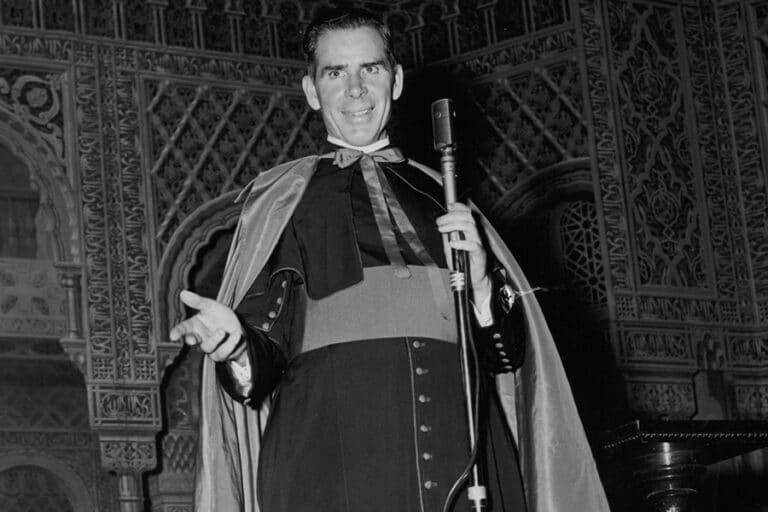
In March 1930, eleven years after his ordination, he began presenting a Sunday evening national radio broadcast called The Catholic Hour. He would carry it for twenty years.
The response was extraordinary. Within a short time he had gathered one of the largest audiences on American radio, reported at some four million listeners a week, and an affection from the public that few preachers have ever known. Many of his listeners asked to be received into the Catholic Church.
Pope Pius XI took notice and named him a Domestic Prelate.
In 1946 he joined the board of the Catholic Medical Mission Board, a service he would continue for thirty years.
Missionary Without Leaving Home (1950 to 1966)
In 1950 he was given charge of the national Society for the Propagation of the Faith in the United States, and he held that office for sixteen years.
It suited him perfectly. He raised millions of dollars for the missions, and more than that, he taught American Catholics to think of the missions as their own concern. His own preaching and example continued to bring converts into the Church throughout these years.
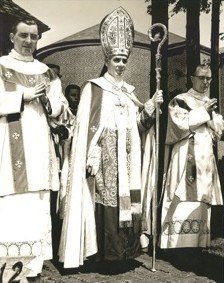
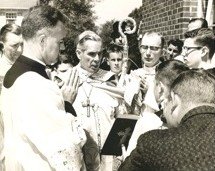
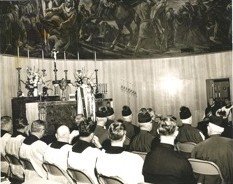
Much of the work was quieter than the broadcasts. The bishop whose name was on a television schedule was also a bishop who came when a parish asked him: to bless a new building, to preach at its dedication, and to stand afterwards in the sun with the people who had paid for it.
Bishop and Television Preacher (1951 to 1957)
On 28 May 1951 he was named Auxiliary Bishop of the Archdiocese of New York.
That same year he moved from radio to the new medium, beginning the programme that made him a household name: Life is Worth Living. It went out on Tuesday evenings at eight o'clock. He took no payment for it. He used no script.
It began on only three stations. Within two months, after Life and Time magazines ran features on him, it was on fifteen. In time it was carried by some five hundred television and radio outlets, and at its height it reached tens of millions of viewers each week. Letters arrived at the rate of eight thousand five hundred a week, and requests for studio tickets ran at four times what could be filled.
He was placed opposite Milton Berle and Frank Sinatra, and he held his ground. In 1952 he received the Emmy Award for Most Outstanding Television Personality. Accepting it, he thanked his writers: Matthew, Mark, Luke and John.
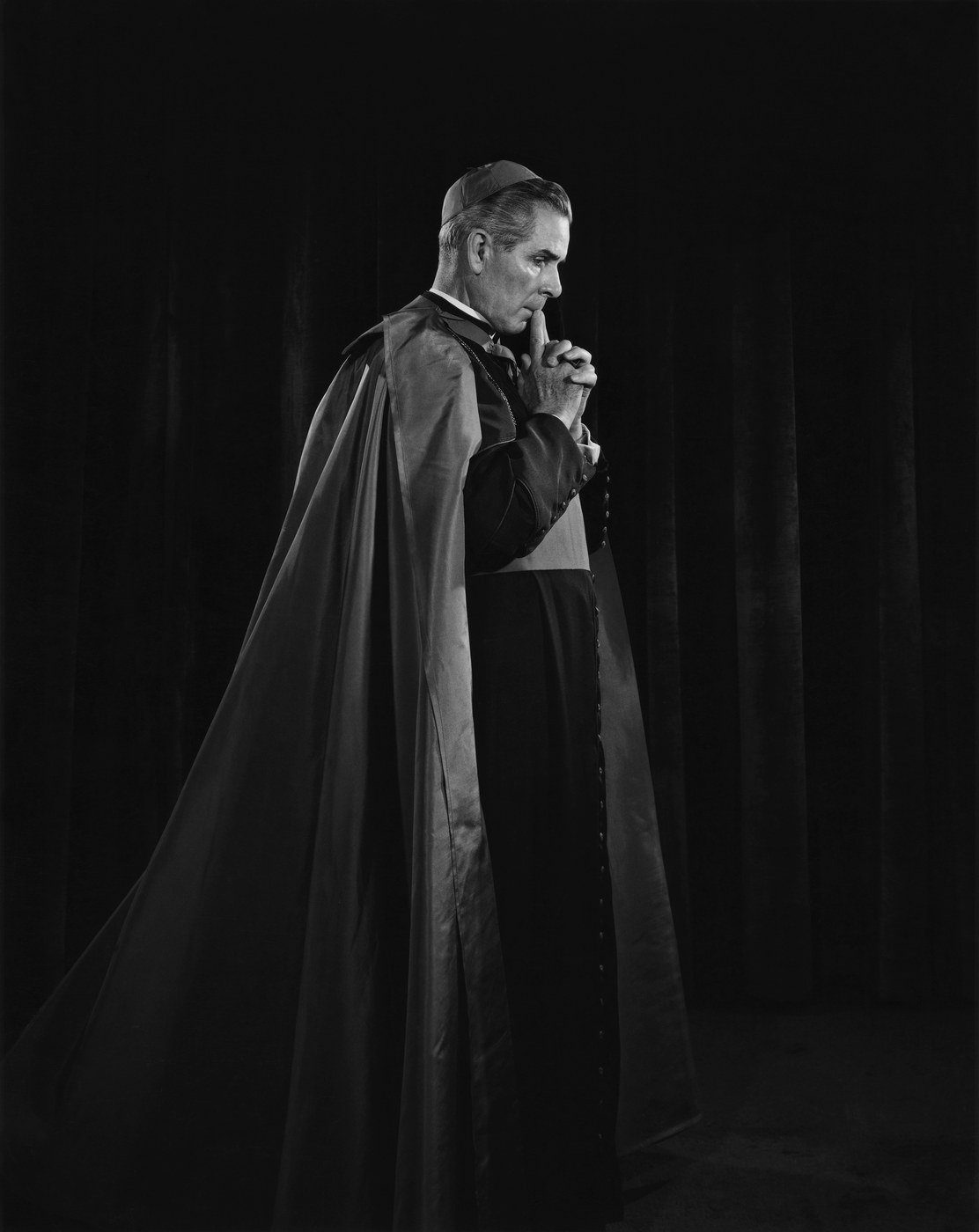
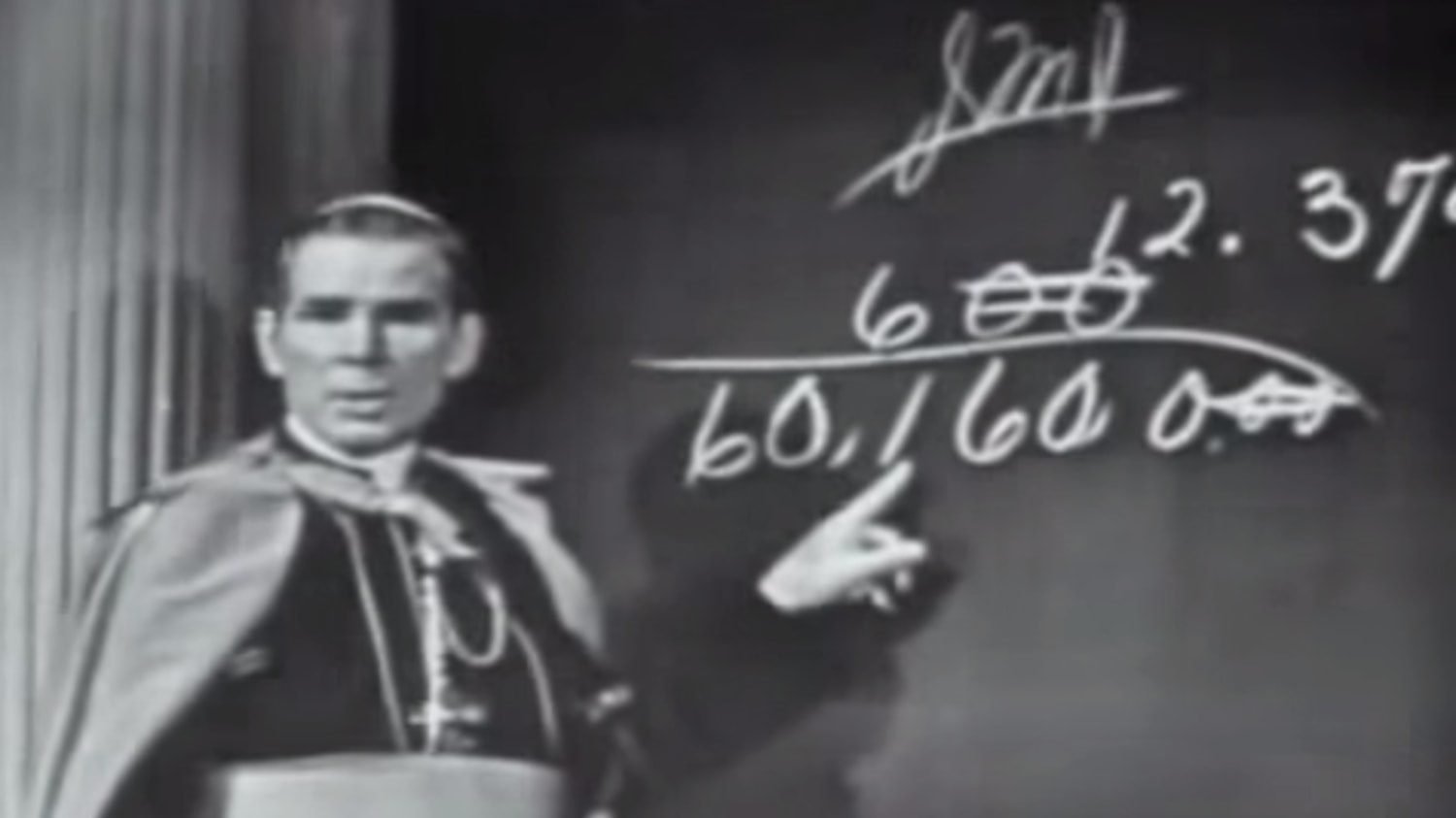
Those who watched him remember the manner almost as clearly as the message. He walked out in cape and pectoral cross onto a set dressed like a quiet study, and he simply taught. When a point needed drawing he turned to a blackboard and set it down in chalk, and by the time he turned back the board was clean again, wiped by a stagehand he always preferred to credit to his angel. He told dry jokes at his own expense. And he was never frightened of silence, letting a pause stand until the sentence before it had settled.
He is often credited, too, with having conducted the first religious service ever broadcast on television.
What made the programme work, though, was not showmanship. It was his gift for taking the hardest truths of the faith and setting them out with a simplicity that a tired man in an armchair could follow. The series ran until 1957.
Trials, and the Council (late 1950s to 1966)
The Church's official account of his life does not pass over the hard years in silence. In the midst of this fruitful apostolate, it says plainly, he met with obstacles, difficulties and disagreements.
He carried them without bitterness, and he kept working. He travelled widely across the world for the missions.
Blessed Pope John XXIII appointed him to the Pontifical Commission for the Evangelization of Peoples and counted him among the more prominent voices in the preparatory sessions for the Second Vatican Council. Pope Paul VI later called on him again for the post-conciliar commission on the missions.
From 1961 to 1968 he presented a second television series, The Fulton Sheen Program, built along the lines of the first.
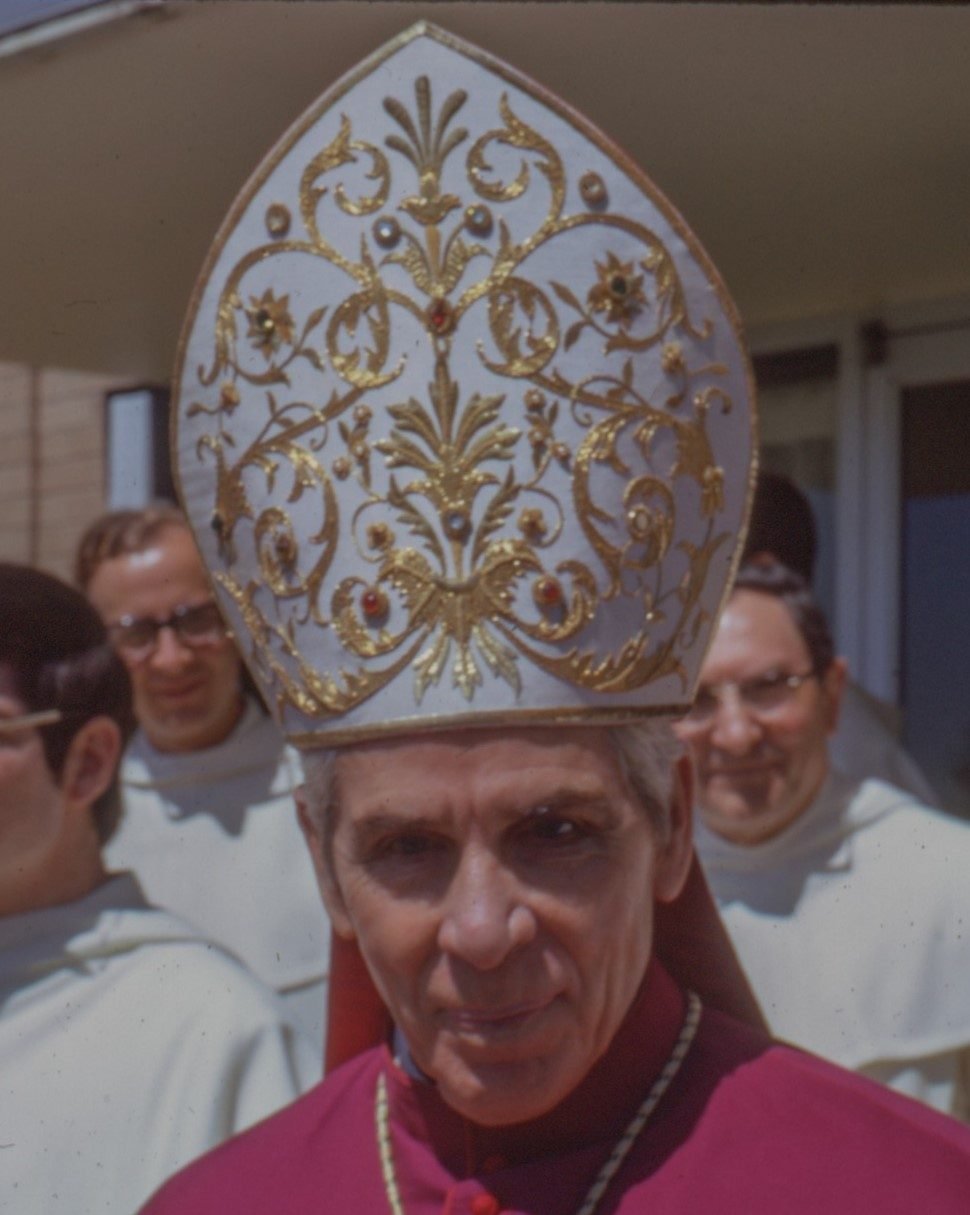
Bishop of Rochester (1966 to 1969)
On 21 October 1966 he was appointed Bishop of Rochester, New York.
He arrived determined to put the Council into practice rather than merely praise it. He reorganized and renewed the institutions of the diocese, strengthened its pastoral work, and gave particular attention to the formation of seminarians and priests.
Above all he turned the diocese towards the poor and the sick, arranging real protection and help for those at the edges. The decree on his virtues describes what he did there as a genuinely frontier ministry, carrying the Church to the weakest members of society. Pope Paul VI held his work in high esteem.
The Hidden Years (1969 to 1977)
In October 1969, after nearly three years in Rochester, the Holy See accepted his resignation and named him titular Archbishop of Newport in Wales. He said he was not retiring, only retreading.
He returned to New York and chose to live in a small and humble house, doing his own household work. The most famous priest in America made his own bed.
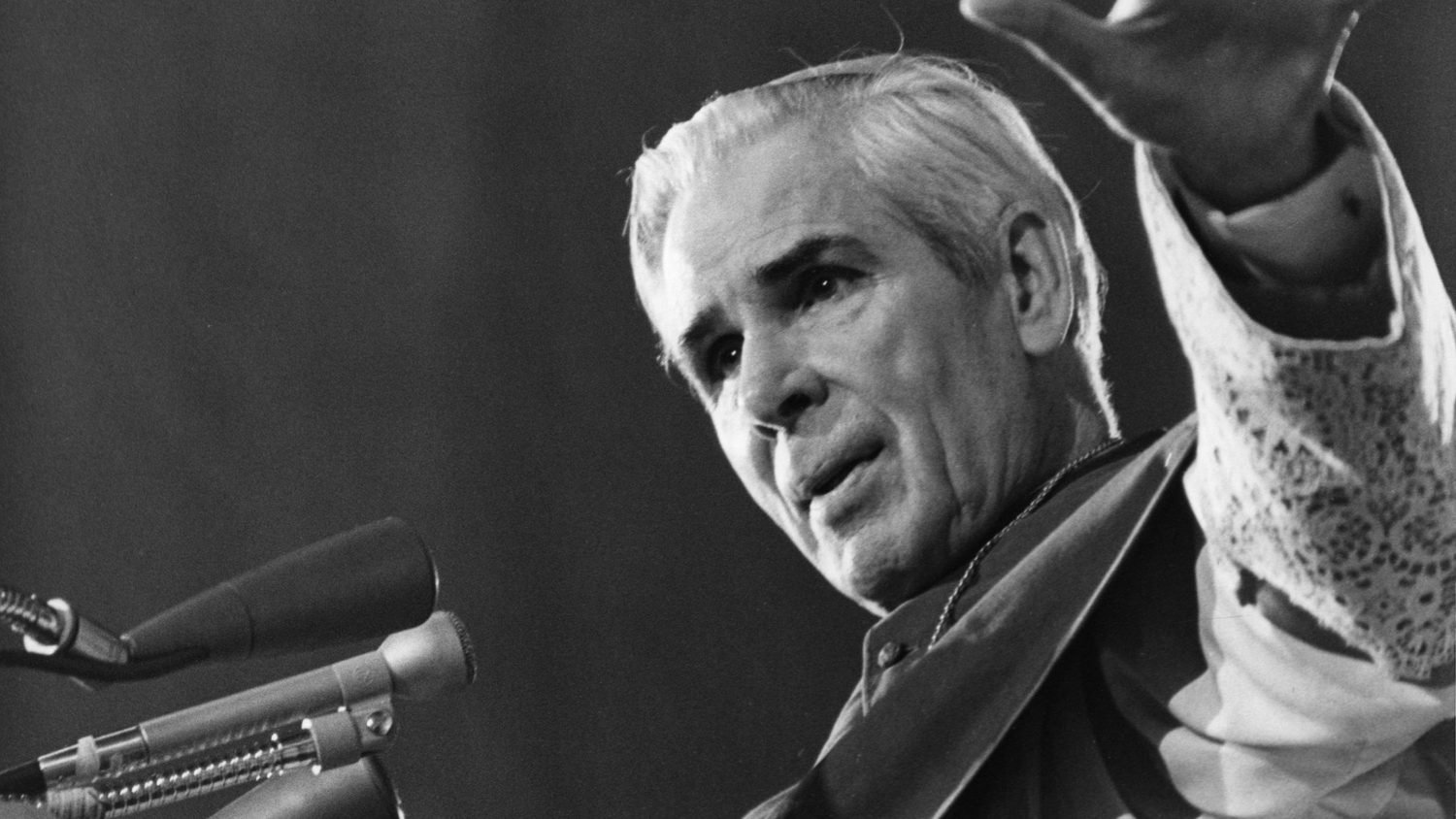
Freed from administration, he went back to what he loved. He preached and taught across the United States and in Europe, and he kept writing. Over his lifetime he produced more than fifty books.
His whole public life rested on a hidden one. The decree of the Church says that his singular pastoral activity was founded and guided by a most firm interior life, sustained each day by the Eucharist, by the prayer of the Church, and by devotion to Our Lady.
He lived in a constant awareness of God's presence, and out of that awareness the virtues came without strain: faith, hope and charity towards God and towards his neighbour, and with them prudence, justice, temperance and fortitude. Those who met him came away with the impression of having met a holy man.
The Last Embrace (1977 to 1979)
On 15 July 1977 he underwent open-heart surgery at real risk to his life. He survived, but his strength never fully returned.
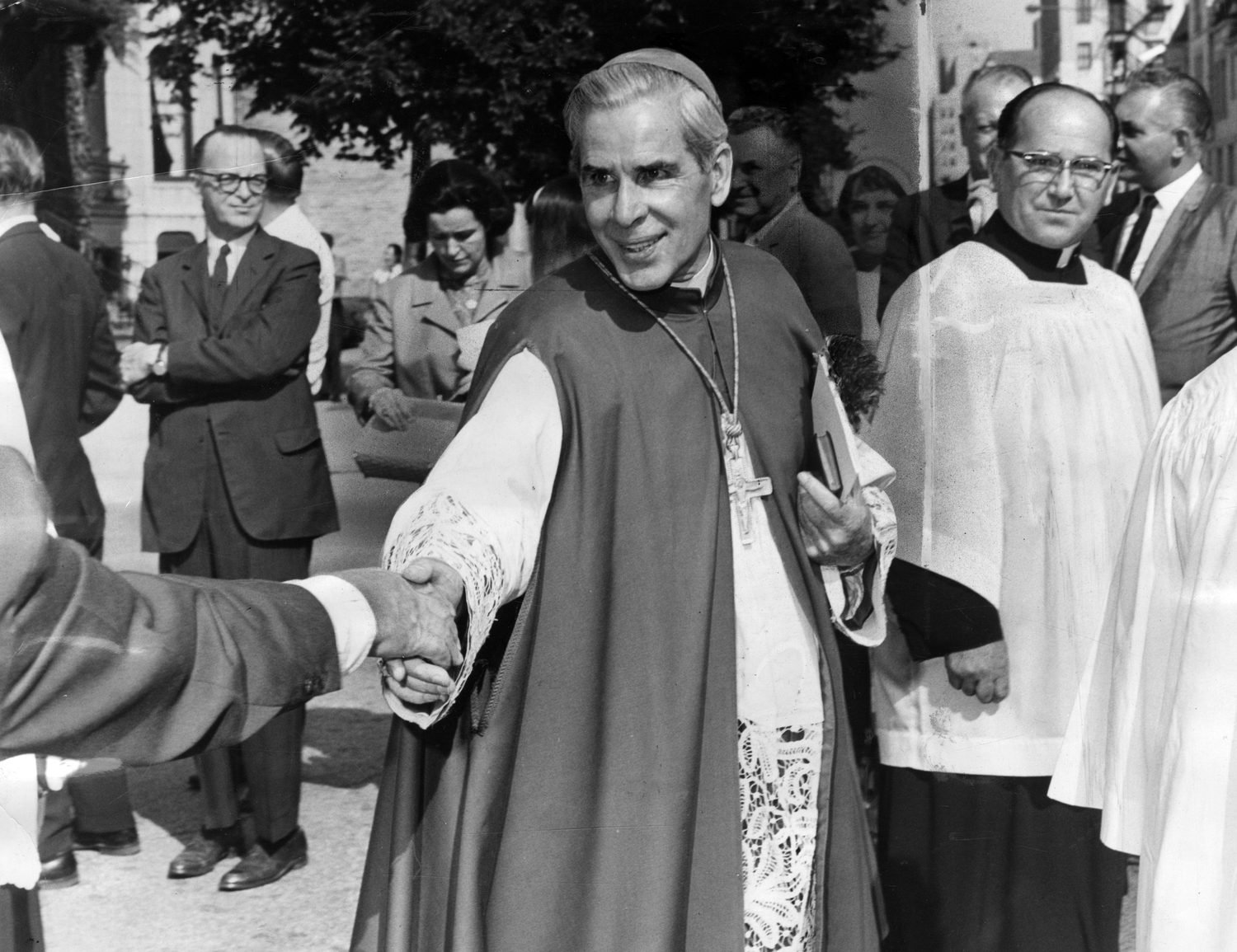
On 2 October 1979, ignoring the state of his health, he insisted on being present when Blessed Pope John Paul II came to St. Patrick's Cathedral in New York during his apostolic visit. He was brought into the cathedral in a wheelchair.
The Pope came to him and embraced him, and praised his constant and ardent devotion to spreading the word of God and his singular fidelity to the Church. The words remembered by those present were these: you have written and spoken well of the Lord Jesus, and you are a loyal son of the Church.

It was the last public moment of his life, and he received it as a seal on everything that had gone before.
Two months later, on 9 December 1979, Fulton John Sheen died peacefully in New York. He was found where he had spent an hour every day for sixty years, before the Blessed Sacrament.
What Happened Next
The story does not end at the grave, and in his case it did not even pause there. People began praying to him almost at once, and in time the Church began to listen.
His cause was opened in Peoria in 2002. He was declared Venerable in 2012, a miracle was recognized in 2019, and his beatification is set for 24 September 2026.
Follow the cause of Venerable Fulton J. Sheen
Why He Still Speaks
Sheen belonged entirely to his own century. He used its newest tools without embarrassment, and he was not afraid of a camera or a studio audience.
Yet nothing he said has aged badly, because he was not really talking about his century at all. He was talking about the restlessness of the human heart, about sin and mercy, about the Cross, and about a God who is love.
He taught in classrooms, in parish churches, over the radio, on television, and in more than fifty books. Through every one of them he did the same thing: he took the faith and made it plain, and he made it beautiful.
He would want the last word to be a simple one. Life is worth living, because the Life that gives it is worth loving.
Ask His Prayers
Fulton Sheen never wanted to be looked at. He wanted to be looked through, the way one looks through a window at the light beyond it.
So the right way to end his story is not to admire him but to ask him. Bring him the thing you are carrying, and let him carry it with you to the Lord he served for sixty years.
Pray with Venerable Fulton Sheen
There you will find the prayer for his intercession, the prayers he himself loved, and the daily Holy Hour that was the hidden source of everything you have just read.