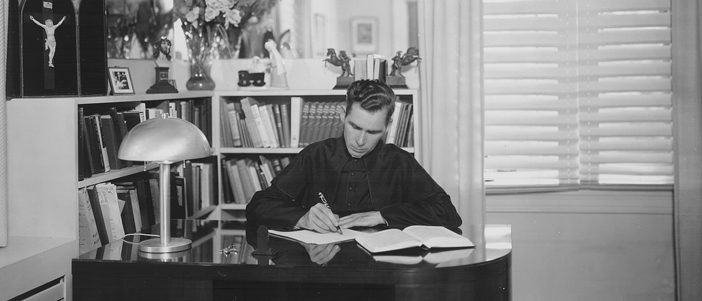
Monsignor Sheen writing at his desk
His Writings

The Books of Fulton J. Sheen

Fifty-five years of writing, from a Louvain thesis in 1925 to the autobiography published the year after he died. Here is the whole shelf.

He published for fifty-five years, from a doctoral thesis dressed as a book in 1925 to an autobiography that appeared the year after he died. What follows is the whole shelf, in the order he wrote it.

Many of these titles are back in print. Others exist only in second-hand copies, and a few are genuinely scarce. Every link below runs a live search rather than pointing at a single listing, so it will keep working as editions come and go.

Where to Start

Seventy titles is daunting. These twelve are the ones in print, the ones most read, and the ones to hand a newcomer.

Life of Christ

1958

His masterpiece. Thirty years of preaching on Christ gathered into one book and organized around the Cross, which he insists was present from the beginning. If you read one, read this.

Find on Amazon →

Peace of Soul

1949

The bestseller. Written against the therapeutic mood of the age: much of what we treat as neurosis is unconfessed guilt, and the confessional does what the couch cannot.

Find on Amazon →

Three to Get Married

1951

The third is God. Still given to engaged couples seventy-five years on, and still the book of his that changes the most lives.

Find on Amazon →

The World's First Love

1952

His book on Our Lady, and the one closest to his own heart.

Find on Amazon →

Treasure in Clay

1980

The autobiography, finished shortly before he died. The Holy Hour, the mistakes, the years of difficulty, told with a candour the public Sheen rarely showed.

Find on Amazon →

Victory over Vice

1939

The seven deadly sins set against the seven last words from the Cross. Short, and one of the best ways in.

Find on Amazon →

Lift Up Your Heart

1950

The companion to Peace of Soul, and the warmer book. How to live once the diagnosis has been accepted.

Find on Amazon →

These Are the Sacraments

1962

The seven sacraments explained one by one. Currently available bound together with Three to Get Married.

Find on Amazon →

The Priest Is Not His Own

1963

Still given to seminarians. The priest is not merely a man who offers sacrifice but a man who is himself the victim.

Find on Amazon →

Communism and the Conscience of the West

1948

The book that made him a public figure beyond the Church. Communism as a heresy rather than a politics.

Find on Amazon →

Life Is Worth Living

1953 onward

The television talks in print. If you have seen the programme, you can hear him on every page.

Find on Amazon →

Go to Heaven

1960

A spiritual road map. Plain instruction on the last things, without a trace of embarrassment.

Find on Amazon →

Finding the Out-of-Print Titles

Most of what follows has not been reprinted since the 1950s, and used copies are the only way to get them. Two places search across many sellers at once:

For current editions, Catholic publishers are worth linking before the large retailers. Sophia Institute Press has republished more than three dozen Sheen titles, and Ignatius Press and TAN Books carry several others.

The Complete Bibliography

The whole shelf, in the order he wrote it. Each link runs a live search, so it keeps working as editions come and go.

The 1920s

  • God and Intelligence in Modern Philosophy Longmans, Green, 1925His doctoral work from Louvain, and the book that won him the Cardinal Mercier Prize. A young philosopher sets Thomas Aquinas against the thought of his own day. Demanding, and not the place to begin.
  • Religion Without God Longmans, Green, 1928An examination of the modern attempt to keep religious feeling while discarding God himself. The argument he would spend the next fifty years making in plainer language.
  • The Life of All Living: The Philosophy of Life The Century Co., 1929His first book for ordinary readers. What life is, what makes one kind of life higher than another, and where the life of God fits. Also issued in an abridged popular edition the same year.

The 1930s

  • The Divine Romance The Century Co., 1930The whole Christian story told as a love affair between God and the human race. One of his most reprinted books, and still one of the most approachable.
  • Old Errors and New Labels The Century Co., 1931Sheen at his most combative, arguing that the fashionable ideas of the day were ancient mistakes wearing modern clothes.
  • Moods and Truths The Century Co., 1932Short essays on the difference between what we feel and what is so. Written for a public that had just discovered him on the radio.
  • Way of the Cross Appleton-Century-Crofts, 1932The fourteen Stations preached in Lent of 1932, when he was thirty-six. Not descriptive but personal: each station is turned round until it points at the reader.
  • The Philosophy of Science The Bruce Publishing Co., 1934On what science can and cannot tell us, and why the two questions are worth keeping apart. A professor's book.
  • The Eternal Galilean Appleton-Century-Crofts, 1934An early life of Christ, and the first sketch of what would become his great book of 1958.
  • The Mystical Body of Christ Sheed and Ward, 1935The Church understood not as an institution but as a living body with Christ as its head. A theme he returned to for the rest of his life.
  • Calvary and the Mass: A Missal Companion P. J. Kennedy and Sons, 1936A short and much loved book showing how the seven last words of Christ correspond to the parts of the Mass. Written to be carried to church.
  • The Moral Universe: A Preface to Christian Living The Bruce Publishing Co., 1936On the moral order as something discovered rather than invented.
  • The Cross and the Beatitudes 1937Four meditations linking the Beatitudes to the Passion. Short, and among the most quoted of his devotional writings.
  • The Cross and the Crisis The Bruce Publishing Co., 1938Written as Europe moved toward war. Sheen reads the crisis as a spiritual one before it is a political one.
  • The Rainbow of Sorrow P. J. Kennedy and Sons, 1938His book on suffering, and for many readers the one that mattered most. Sorrow is not explained away but given a place in the pattern.
  • Liberty, Equality and Fraternity Macmillan, 1938The three words of the French Revolution examined, and argued to be unattainable on the terms that produced them.
  • Victory over Vice P. J. Kennedy and Sons, 1939The seven deadly sins set against the seven last words from the Cross. Still in print, and still one of the best introductions to him.

The War Years

  • Freedom under God The Bruce Publishing Co., 1940On liberty as something that depends on God rather than on the state. Written as the totalitarian regimes were at their strongest.
  • The Seven Virtues P. J. Kennedy and Sons, 1940The companion to *Victory over Vice*: faith, hope, charity, prudence, justice, temperance and fortitude, each given a chapter.
  • Whence Comes War Sheed and Ward, 1940Where war actually begins, in Sheen's reading: not in treaties or economics but in the disordered human heart.
  • For God and Country P. J. Kennedy and Sons, 1940On patriotism and faith, and how each is deformed when it swallows the other.
  • A Declaration of Dependence The Bruce Publishing Co., 1941The title is the argument. Against the American founding document, Sheen sets the older truth that we did not make ourselves.
  • God and War P. J. Kennedy and Sons, 1942Written after America entered the war, for people trying to hold faith and catastrophe in the same mind.
  • The Armor of God: Reflections and Prayers for Wartime P. J. Kennedy and Sons, 1943A pocket prayer book for soldiers, small enough to carry in a uniform. It went into foxholes, ships and prison camps. Reissued in our own time as *Fulton Sheen's Wartime Prayer Book*. An abridgement, *The Shield of Faith*, appeared the same day from the same publisher.
  • The Divine Verdict P. J. Kennedy and Sons, 1943On judgment, human and divine, written in the middle of a war that had made the question urgent.
  • Philosophies at War Charles Scribner's Sons, 1943His argument that the war was a contest between ideas about the human person, and that the ideas mattered more than the armies.
  • Seven Words of the Cross P. J. Kennedy and Sons, 1944The last words of Christ, preached at the Good Friday Three Hours. The form he returned to more often than any other.
  • Love One Another P. J. Kennedy and Sons, 1944On charity as a command rather than a sentiment, published while the world was doing the opposite.
  • Seven Pillars of Peace Charles Scribner's Sons, 1944What a just peace would require once the fighting stopped. Sheen writing as a public commentator as much as a priest.
  • Seven Words of Jesus and Mary P. J. Kennedy and Sons, 1945The words of Christ set beside the words of his mother, drawn from Cana and Calvary.

The Post-War Books

  • Preface to Religion P. J. Kennedy and Sons, 1946Written for people standing outside the door. What religion is for, before any question of which one.
  • Characters of the Passion Garden City Books, 1946Pilate, Judas, Peter, the soldiers, the crowd. Each figure of the Passion examined as a type of something in us.
  • Philosophy of Religion: The Impact of Modern Knowledge on Religion Appleton-Century-Crofts, 1948His most substantial academic work of the period, and the last book in which the professor clearly outranks the preacher.
  • Communism and the Conscience of the West Bobbs-Merrill, 1948The book that made him a figure in American public life beyond the Church. His argument is that communism is a heresy rather than merely a politics, and that the West cannot answer it while sharing its materialism.
  • Peace of Soul McGraw-Hill, 1949His best-known book and a genuine bestseller. Written against the therapeutic mood of the age, it argues that much of what we treat as neurosis is unconfessed guilt, and that the confessional does what the couch cannot. **The one to read first.**

The 1950s: The Television Years

  • Lift Up Your Heart McGraw-Hill, 1950A companion to *Peace of Soul*, and in some ways the warmer book. On how to live once the diagnosis has been accepted.
  • Three to Get Married Appleton-Century-Crofts, 1951The third is God. Still given to engaged couples seventy-five years on, and still the book of his that changes the most lives.
  • The World's First Love McGraw-Hill, 1952His book on Our Lady, and the one closest to his own heart. An abridgement on the Rosary appeared in 1978 as *The World's Great Love*.
  • Way to Happiness Maco Magazine Corp., 1953Short pieces for a general readership, from the years when he was on television every week.
  • Life Is Worth Living (First Series) McGraw-Hill, 1953The television talks in print. If you have seen the programme, you can hear him on every page.
  • Life Is Worth Living, Second Series McGraw-Hill, 1954The second season, same form.
  • The Church, Communism and Democracy McGraw-Hill, 1954Talks from the series gathered around a single theme, at the height of the Cold War.
  • Life Is Worth Living, Fourth Series McGraw-Hill, 1954A further gathering from the programme.
  • The Life of Christ Maco Magazine Corp., 1954A shorter illustrated life, distinct from the great 1958 book of nearly the same name.
  • Way to Happy Living Maco Magazine Corp., 1955More short pieces in the same popular format.
  • Thinking Life Through McGraw-Hill, 1955Television talks on the questions people actually lie awake with.
  • God Love You Doubleday, 1955Named for the phrase he ended every broadcast with, and for his column in the mission magazine. Short reflections, one to a page.
  • Way to Inner Peace Garden City Books, 1955Brief daily reflections, widely reprinted. A good bedside book.
  • Thoughts for Daily Living Garden City Books, 1956A year of short reflections. Also published in Dublin the same year.
  • Life Is Worth Living, Fifth Series McGraw-Hill, 1957The last of the printed series, from the final season of the programme.
  • Science, Psychiatry and Religion Dell, 1957A paperback original taking up the quarrel of *Peace of Soul* directly, and with more care for what psychiatry gets right.
  • Life of Christ McGraw-Hill, 1958**His masterpiece.** Everything he had preached about Christ for thirty years, gathered into one book and organized around the Cross, which he insists was present from the beginning. If you read only one book by Fulton Sheen, read this one.

The 1960s

  • Go to Heaven McGraw-Hill, 1960Subtitled a spiritual road map. Plain instruction on the last things, written without a trace of embarrassment.
  • These Are the Sacraments Hawthorn Books, 1962The seven sacraments explained one by one, originally with photographs. Revised in 1964, and back in print today.
  • The Priest Is Not His Own McGraw-Hill, 1963Written for priests, and still given to seminarians. The argument is that the priest is not merely a man who performs sacrifice but a man who is himself the victim.
  • Missions and the World Crisis Bruce, 1963From the years he directed the Society for the Propagation of the Faith. The missions read against the politics of the decade.
  • The Power of Love Maco Magazine Corp., 1964Short reflections on love in its several senses. Reissued by Simon and Schuster the following year.
  • Walk with God Maco Magazine Corp., 1965Daily companionship rather than argument. One of the gentlest books he wrote.
  • Christmas Inspirations Maco Magazine Corp., 1966Reflections for Advent and Christmas. Republished in 1984 as *Rejoice!*
  • Footprints in a Darkened Forest Meredith Press, 1967Subtitled vital words for a changing world. Sheen addressing the upheaval of the late 1960s, in the Church and outside it.
  • Guide to Contentment Maco Publishing Co., 1967Short pieces on what contentment is and where people look for it in vain.
  • Lenten and Easter Inspirations Maco Publishing Co., 1967Reflections for the season. Republished in 1984 as *Cross-Ways*.
  • That Tremendous Love Harper and Row, 1967An anthology of quotations, poems, prayers and reflections drawn from across his work.

The Last Books

  • Children and Parents Simon and Schuster, 1970Written just after Rochester, on family life in a decade that was rearranging it.
  • Those Mysterious Priests Doubleday, 1974His second book for priests, written near the end of his life, when many were leaving. A defence of the priesthood by a man who had loved it for fifty-five years.
  • Treasure in Clay: The Autobiography of Fulton J. Sheen Doubleday, 1980Finished shortly before his death and published the year after. He writes about the Holy Hour, about his mistakes, and about the years of difficulty, with a candour the public Sheen rarely showed. **The best single book about him is the one he wrote himself.**

Still in Print

Many titles above have been reissued, and several publishers keep a Sheen list. Worth linking from this page:

  • All Fulton Sheen books on Amazon
  • Sophia Institute Press has republished more than three dozen of his titles
  • Ignatius Press carries Life Is Worth Living, The World's First Love and others
  • Newer anthologies gather his writing by theme, including one collecting everything he wrote on prayer